


There’s a myth we’re taught as ambitious women: we can handle immense stress.
By keeping our composure at work, we think we’re fine. We power through the day and switch it off when we get home. But workplace stress rarely disappears the moment we come home.
It starts quietly, following us home. It makes us less patient and short-tempered, snapping at the tiniest things and reacting in ways that don’t match the situation. Then it starts to get louder.
It becomes a fatigue so chronic that being emotionally present feels impossible. You’re physically there, but your mind is running in the background, responding, bracing, and producing.
And those behaviors all spike your nervous system. You can’t calm down enough to sleep, or you wake up already anxious, or you carry a tightness in your chest that never fully releases.
Meanwhile, at work, you hold your decorum in meetings, get all your tasks done (and more), and you’re constantly performing. But the reality is that the impact shows up where it matters most: your health, your relationships, and your sense of self.
And years later, when we look back, those work moments will have faded. But, in its place will be a place of longing: wishing we felt more, were more present, or weren’t living life in survival mode.
There’s no way to contain stress, it will seep into every aspect of your life.

Our workplace culture shapes our nervous system.
I didn’t always understand that direct impact. Early in my career, I had two interactions with managers that I still remember because they were trivial on the surface but powerful underneath.
One told me I wasn’t using enough exclamation marks in my emails. The implication: I wasn’t friendly enough. Not warm enough. Not “likeable” enough. Another expressed concern that I didn’t respond quickly enough to Lynx messages (remember the clunky precursor to Teams), worried I didn’t receive their directive or that I was ignoring them.
Neither had anything to do with outcomes. Both were 100% about control.
And micromanagement like that doesn’t just frustrate you. It conditions you. Teaching you to be on edge, anticipate criticism, and constantly scan for what you might be doing wrong. Even if you’re doing everything right.
It’s no wonder that I internalized those two experiences.
In response, I became faster, more responsive, and more vigilant. I improved my performance, but also increased my perfectionism and self-criticism.
Those behaviors seemed to work, leading to bigger promotions and better titles. But eventually, it caught up with me.
I had a wake-up call that forced me to slow down. Not because I consciously wanted to, but because my body required it. After a near-death experience (which I share in more detail in my gratitude story),

I knew I had to make changes. Changes that helped me learn, grow, and evolve.
But here’s the truth: even when we make those conscious efforts, it doesn’t change society.
Those disruptive leadership styles and poor managers persist, marked by passive aggression, a need for control, unrealistic expectations, and constant urgency disguised as ‘standards of excellence’. So it shouldn’t have surprised me that years later, I was headed down a similar path.
When I recognized the early signs of a flare, I scheduled an urgent rheumatology appointment. I refused to let what happened to me in 2015 happen again because this time, it hit differently. This time, the stakes were so much higher. Now, I had a partner and an infant who needed me. If I kept living the same way, the consequences wouldn’t only be mine.
This time, I wasn’t looking for temporary solutions; I wanted a long-lasting change. Not just to my work standards, but to my patterns for defining success and the kind of life I wanted to lead. Opening my mind to a new way of being, one where I wasn’t required to live in survival mode to succeed.
That’s what led me to embodied leadership.
It’s not about a better productivity system; it’s about building a new foundation.
Embodied (or body-led) leadership is a management practice built on a regulated nervous system, grounded presence, and authentic alignment.
At its core, it focuses on:
Regulation: the ability to calm your body under pressure instead of living in chronic stress
Presence: being fully here, not constantly in the next moment
Authenticity: responding from truth instead of performance
Integrity: choosing based on values, not fear
Energetic awareness: noticing what drains you, what fuels you, and what you’re absorbing
It takes a deeply practical approach, recognizing that your body is the first place stress shows up and the first place your life starts to fracture when something is unsustainable. This style of leadership is valuable in your career for obvious reasons: clarity, steadiness, trust, resilience, but more so, it can transform how you show up at home.
Because the ability to regulate your nervous system and stay grounded under pressure is a leadership skill, whether you’re:
navigating a high-stakes meeting, or
responding to a toddler tantrum, or
holding space for a partner who had a hard day, or
trying to make dinner while your mind is still answering emails.
Embodied leadership is not about being calm all the time. It’s about being less reactive and more intentional, ‘showing rather than telling’ through authenticity. Because your nervous system communicates before your words do.
And that presence is contagious: leading from regulation signals safety, while leading from panic spreads panic. There’s a confidence that comes when others can not only hear but also mirror a permission to breathe.
Now, I believe the way you lead says less about how you are as a boss or manager and more about how you live.
Whether you manage a team, run a household, lead a relationship, build a business, care for a child, or care for yourself, you’re leading.
And those small moments count. Whether it’s a harsh email, a toddler meltdown, a tense conversation, or the mental load at 10:00 pm. Those moments add up.
And when we don’t have tools to let our bodies rest and reset, we default to reaction, impatience, or shutdown.
Like any new skill, it requires practice.
Whether you’re managing a team, household, or relationship, caring for a parent or child, or attending to your own needs, you’re always leading. Situations like receiving a harsh email, calming a toddler’s meltdown, or handling a tense dinner conversation can trigger a nervous system response. Small moments matter; your reactions in these moments count. Without tools to help our bodies rest and reset, we tend to react impulsively, become impatient, or shut down.
So, what actions can we take, and when?
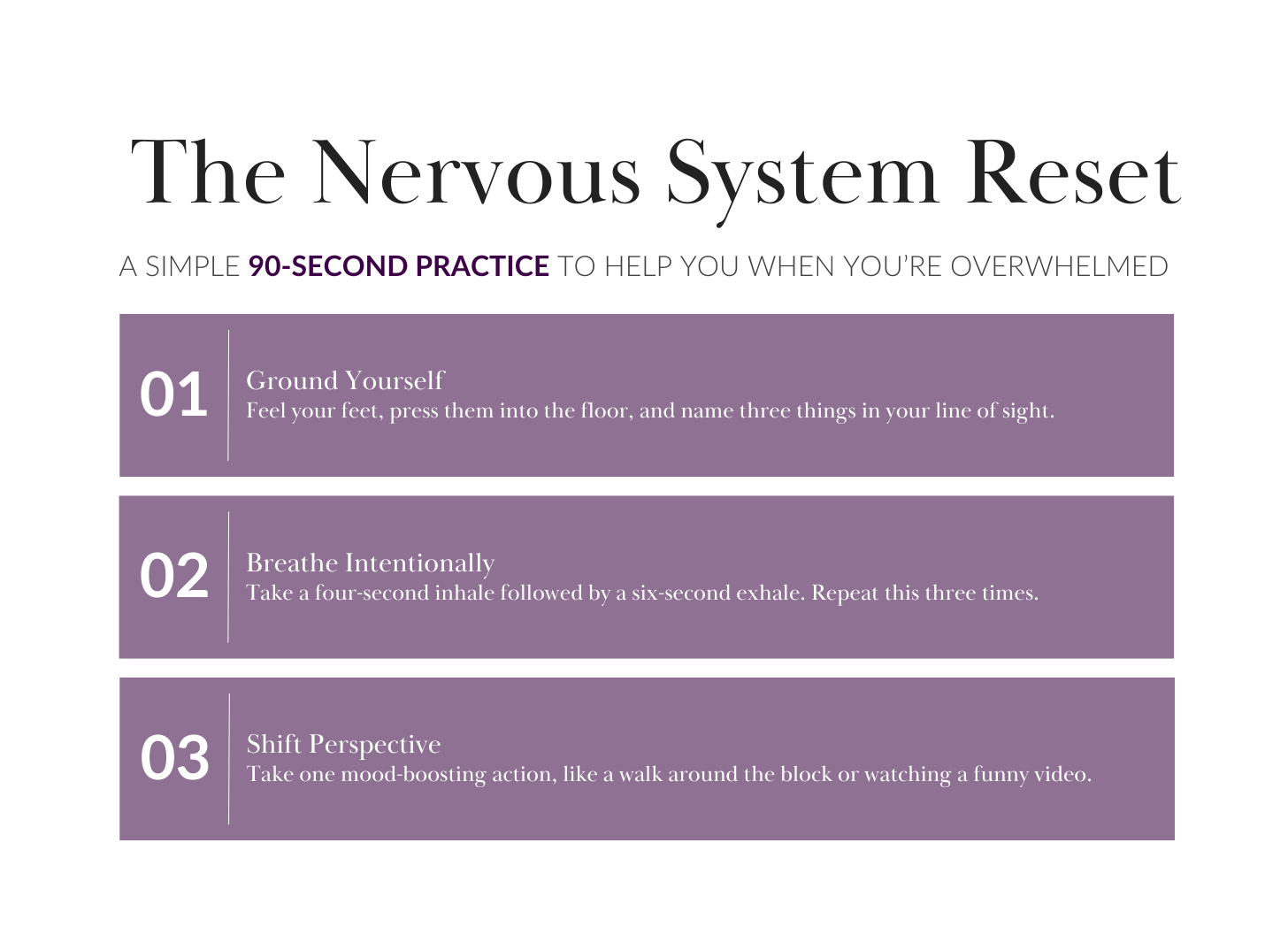
There are subtle signs that we’ve reached our limit and that stress may escalate. These often appear as physical cues: a clenched jaw, tense shoulders, or a sudden, unnecessary sense of urgency. If you can catch it in the moment, try a quick 60-90-second nervous system reset, broken into three parts:
Ground Yourself: Feel your feet, press them into the floor, and name three things in your line of sight.
Breathe Intentionally: Repeat a four-second inhale followed by a six-second exhale, three times.
Shift Perspective: Take one mood-boosting action, like a walk around the block or my go-to: watching a short, funny video.
Of course, if you’re like me and a nervous system reset doesn’t come naturally or is often bypassed in the moment, there are some ways to practice this every day:
Spending five minutes in silence before checking your phone
Walking without multitasking (e.g., leave your AirPods at home)
Conducting a body scan in the shower
Creating a reset playlist to transition from work to home
It’s a process, and it doesn’t happen overnight. These quick activities, when done consistently, can help change your baseline.
We only get one life, let’s live it.
Just because toxic behaviors have been normalized doesn’t mean we have to perpetuate them. We don’t have to accept control cultures, chronic urgency, and survival-mode productivity as the price of success.
If you’re feeling the after-effects of high-performance stress—short temper, exhaustion, restlessness, disconnection—consider this your permission slip: You’re not failing for recognizing it. You’re choosing another way.
When we look back on our lives, we don’t want to wish we had done something differently. Instead, we can commit now to being healthier, kinder, more connected, and more ourselves.