


There’s a kind of exhaustion that doesn’t come from doing too much. It comes from carrying too much—mentally, emotionally, logistically—without anyone seeing it.
The quiet work of running a life with all the tabs open in your mind. The constant remembering, anticipating, coordinating, smoothing, and managing.
For many of us, the invisible load stretches across everything at once: work (and for some of us, businesses), kids, partners, family obligations, community responsibilities, friendships, personal growth, and the emotional labor of being the person people count on.
And when you’re ambitious and a mother, the load can feel like the cost of being capable.
It’s not always the work that breaks us. It’s the constant carrying.
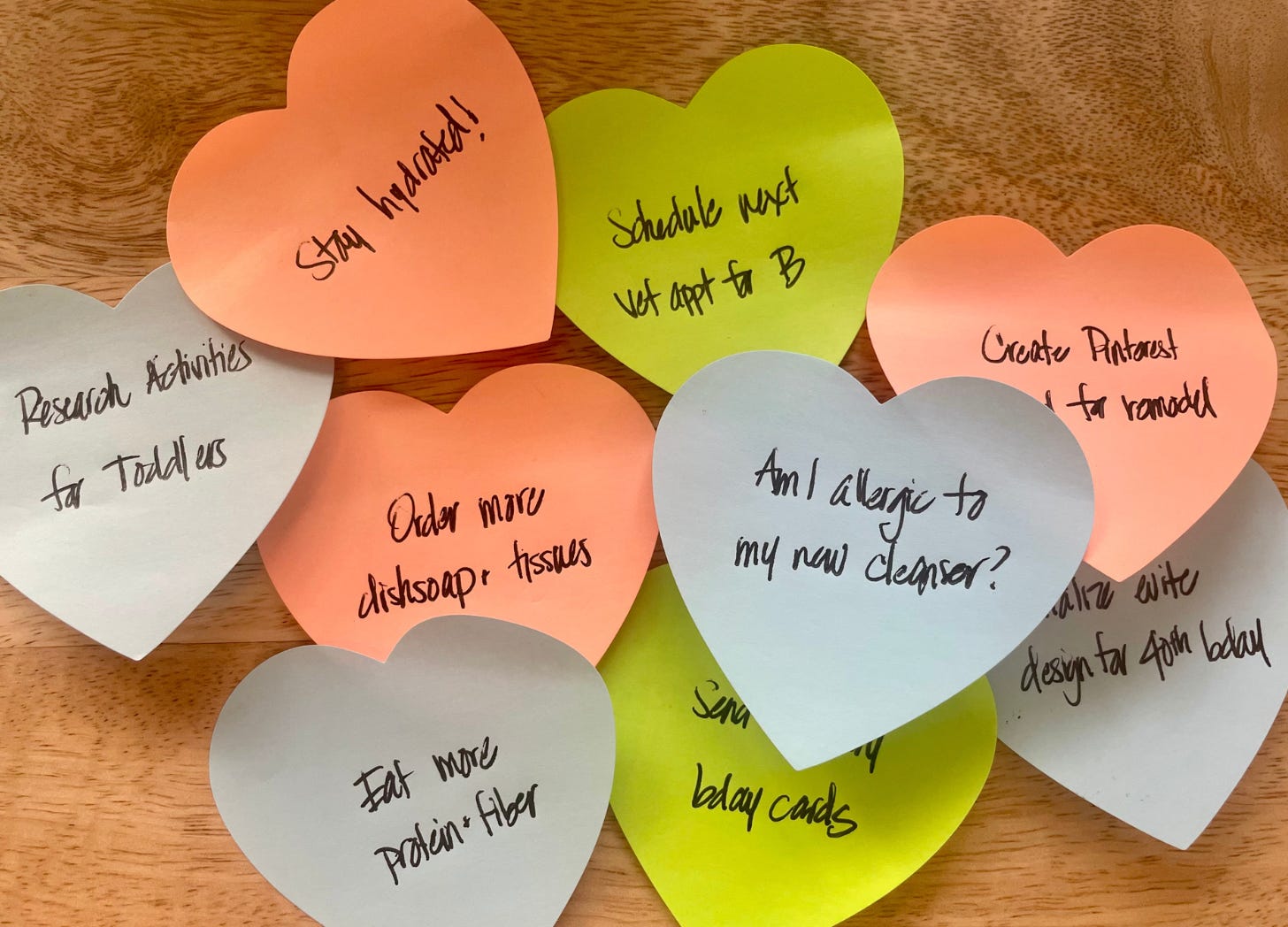
When ‘being capable’ becomes a performance you can’t stop.
Every so often, a familiar feeling rises in me.
It’s not a single task or one hard day. It’s the weight of it all, that reminder of all life’s responsibilities.
When that feeling hits, the pressure quickly morphs the stress into something outward: performance.
Not just at work, but in the way I show up as:
The responsible one.
The organized one.
The resilient one.
The one who remembers.
The one who makes it easier for everyone else.
That pressure then finds its way into how I behave behind closed doors. Sometimes it’s me being irritable. Other times, it’s a numbness. But, as my partner will tell you, it’s most often a drive to get things done – plan more, produce more, clean more. A proof point that I’m on top of it and I’ve got this.
But underneath it all, there’s one question that I have to keep reminding myself to ask: Just because I can, should I?
High performance often hides depletion.
As someone who has a hard time not letting the invisible load take over, it’s important to remember that it’s a slippery slope. It’s dangerous because it doesn’t always look like a struggle. Often, it’s the opposite. It looks like competence.
The invisible load can look like:
being the one who always has it handled
answering the texts quickly, keeping the plans moving
remembering birthdays, deadlines, and school requests
saying yes because it’s easier than explaining why it’s a no
taking on more because it’s faster than delegating
being dependable even when you’re empty
But over time, powering through can start to weigh on you. It doesn’t just show up as being exhausted; you feel disconnected from yourself.
You start feeling resentful toward the people you love, with a short fuse, losing patience faster, feeling like all your creativity has dried up, that your nervous system is in overdrive, that rest is simply unproductive time rather than restoration, and you forget what you need because everyone else’s needs supersede yours.
Setting boundaries isn’t about saying no; it’s saying yes to your life.
As ambitious, high-achieving, and fully capable women, we struggle with boundaries. We correlate them with rejection. Translation: we’re being cold, unavailable, and selfish.
In reality, boundaries are what we need to become aligned.
If you’re like me and see boundaries as letting someone down, try reframing it to show what you’re actually giving everyone in the long run.
Instead of thinking “I’m saying no,” shift the focus:
I’m protecting my energy.
I’m protecting my nervous system.
I’m protecting my presence.
I’m protecting my ability to love well.
Because when you create space, something beautiful happens. It frees you to enjoy your life again by loving more deeply, laughing more genuinely, and being present and in the moment.
The truth is, reconnecting with yourself and restoring ultimately gives you the ability to be more present with others.
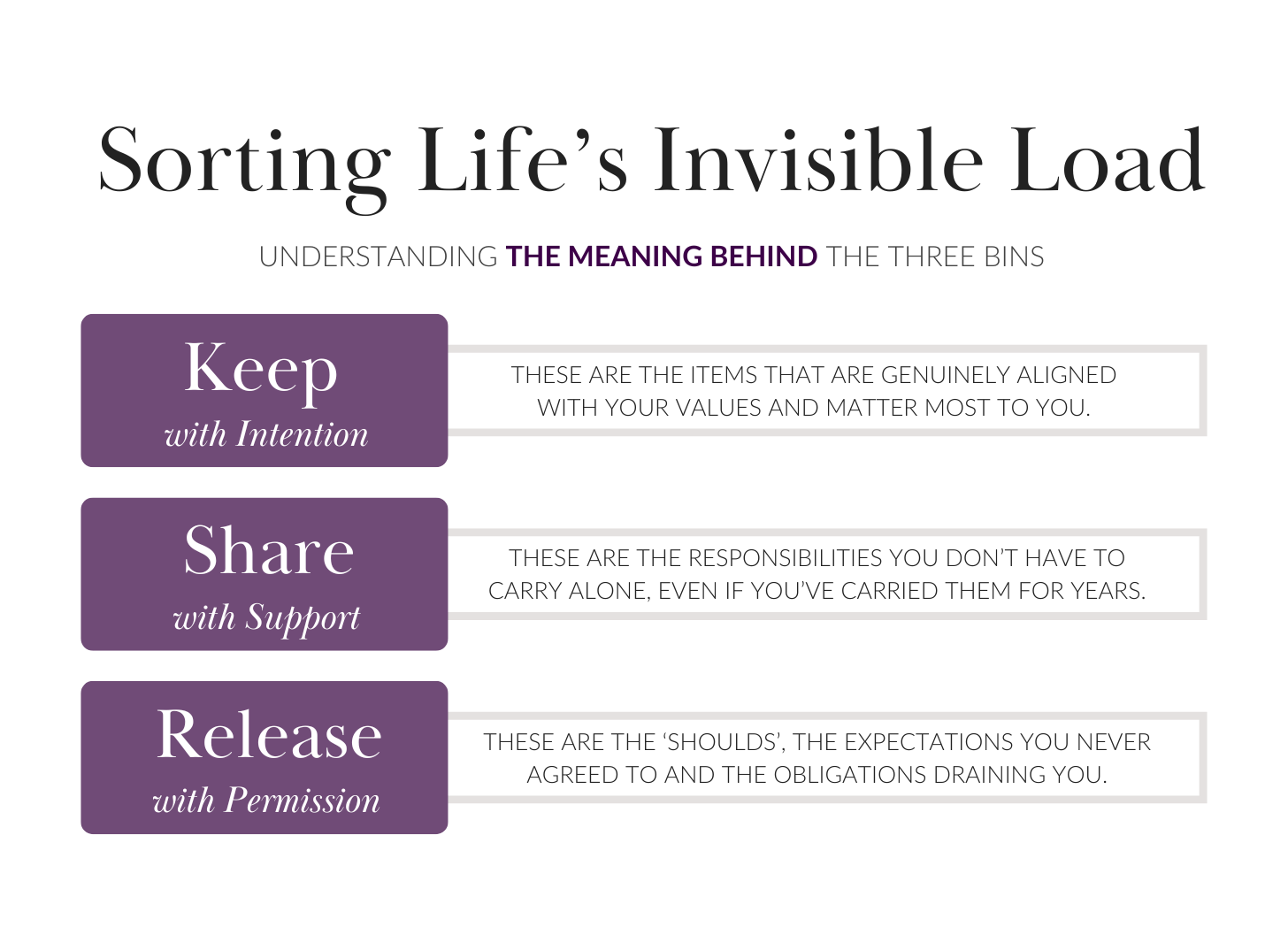
Name it. Sort it. Choose one space-making move.
If boundaries are how we protect our energy, then this is how we begin to create the space we need.
It’s not about having a better plan. It’s about lightening the load, a load we were never supposed to carry alone.
Here’s a practice that you can do in 10 minutes to reconnect when that overwhelming feeling starts to creep in:
Step 1: Write the invisible load list.
Write down 10-15 things that you’re carrying that most people don’t see. If you’re struggling to come up with the items, start with some prompts:
I’m the one who always remembers _______.”
I’m the one who always handles ________.”
I’m the one who thinks ahead about __________.”
I’m the one who absorbs ___________.”
Step 2: Sort it into three bins.
Pick out three highlighters or decide on three symbols that will help you decide what to keep, share, or release.
Keep: These are the items that are genuinely aligned with your values and matter most to you.
Share: These are the responsibilities you don’t have to carry alone, even if you’ve carried them for years.
Release: These are the ‘shoulds’, the expectations you never agreed to and the obligations draining you.
Step 3: Apply it with one action each week.
Choose just one space-making move from one of the three bins. Not one from each, just one total.
Keep = Protect one activity: Time-block it on your calendar, make it a non-negotiable, and treat it like a work meeting.
Share = Delegate a task: Ask for help with a recurring task, share responsibility, assign ownership, not just assistance.
Release = Delete an item: Drop one obligation bogging you down, say no to one ‘should’, stop volunteering yourself by default.
Once you’ve gotten through the list, feel free to repeat it monthly, quarterly, or however often you need to until you start feeling like you’re lightening the invisible weight on your shoulders.
Let’s stop carrying it alone.
If this concept resonates, I want to make it more normal to share what we often keep inside with others, because the invisible load is less burdensome when it’s named and we know we’re not alone.
Name one invisible load you’re carrying. A phase is enough.
Finish this sentence: “This year, I’m making space for _______.”
Say this out loud (even if it’s hard): “I’m not saying no; I’m saying yes to me.”
If you’re comfortable, share one thing you’re keeping, sharing, or releasing.
Reconnection doesn’t require us to reinvent ourselves. It starts with remembering who we are, what we need, and why it matters.
If you’re entering this year feeling heavy, let this be your permission slip: You don’t have to carry it all. AND, you don’t have to carry it alone.
This is such an important topic. I can only speak for myself, but so much of my life I ran on autopilot—purse "git-r-dun" mode. And when I finally had a moment to myself, it was complete depletion. No energy left for anything. The moment that hit hardest: my son saying to me, "The only thing you care about is work."
I'm at a different stage of life now—the sandwich generation, with my son grown but still needing attention and an aging parent who needs me too. The load just shifts shape but doesn't lighten. So this advice still holds true. Thank you for the reminder and for helping others find a new perspective on something many of us carry silently.
Oh, my, this newsletter is packed with valuable advice that requires reading and rereading! I used to roll my eyes when educators would say, "Lifelong Learning." This month I turn 73; lifelong learning is real. My invisible load that's a keeper.