


No matter our accolades, experience, or expertise, many ambitious women carry a certain tension. On one side, we want to be seen, contribute, and share what we’ve learned. But often, we hesitate. Why? Because visibility can feel like a performance, we avoid it.
We don’t want to sound braggy or feel exposed. We’re afraid of being perceived as ‘too much’ or of saying the wrong thing, offending someone, or opening ourselves up to criticism.
So, many high-achieving women have learned to do this: stay behind the scenes, let our work quietly speak for itself, and support others’ visibility (all while questioning our own).
But I believe this: we don’t need to perform to be visible; we just need to be real.
Non-performative visibility means sharing from truth, not trying to prove. It’s showing up as yourself—with clarity and intention—rather than a curated version aimed at approval.
For years, I was more comfortable shaping others’ narratives.
As a publicist, I am very familiar with what it takes to share captivating stories, position myself as a leader, and present as an expert. I know how to make others appear confident, compelling, and credible.
But for myself? I preferred the role of strategist—the one behind the scenes with the plan who could control the message but remained out of the spotlight.
Then something happened last fall that surprised me. During an unassuming date night with my husband, a modeling agent approached me, introduced herself, and handed me her card. I didn’t expect it, and honestly, I almost dismissed it.
But I followed up and am proud to now be represented by The Block Modeling Agency.
That might sound like a fun plot twist (and it is), but what it unlocked for me went deeper than modeling. Growing up in Iowa as a South Asian girl, I was always chasing a version of beautiful that wasn’t built for me.
The Midwest norm I grew up around celebrated a very specific kind of all-America beauty: white, blonde, blue-eyed, athletic, effortlessly girl-next-door pretty. And I wasn’t that. I was a brown girl with dark hair and dark eyes—an hourglass shape. Smart, musical, athletic—multi-dimensional in ways that didn’t match the stereotype I saw celebrated around me.
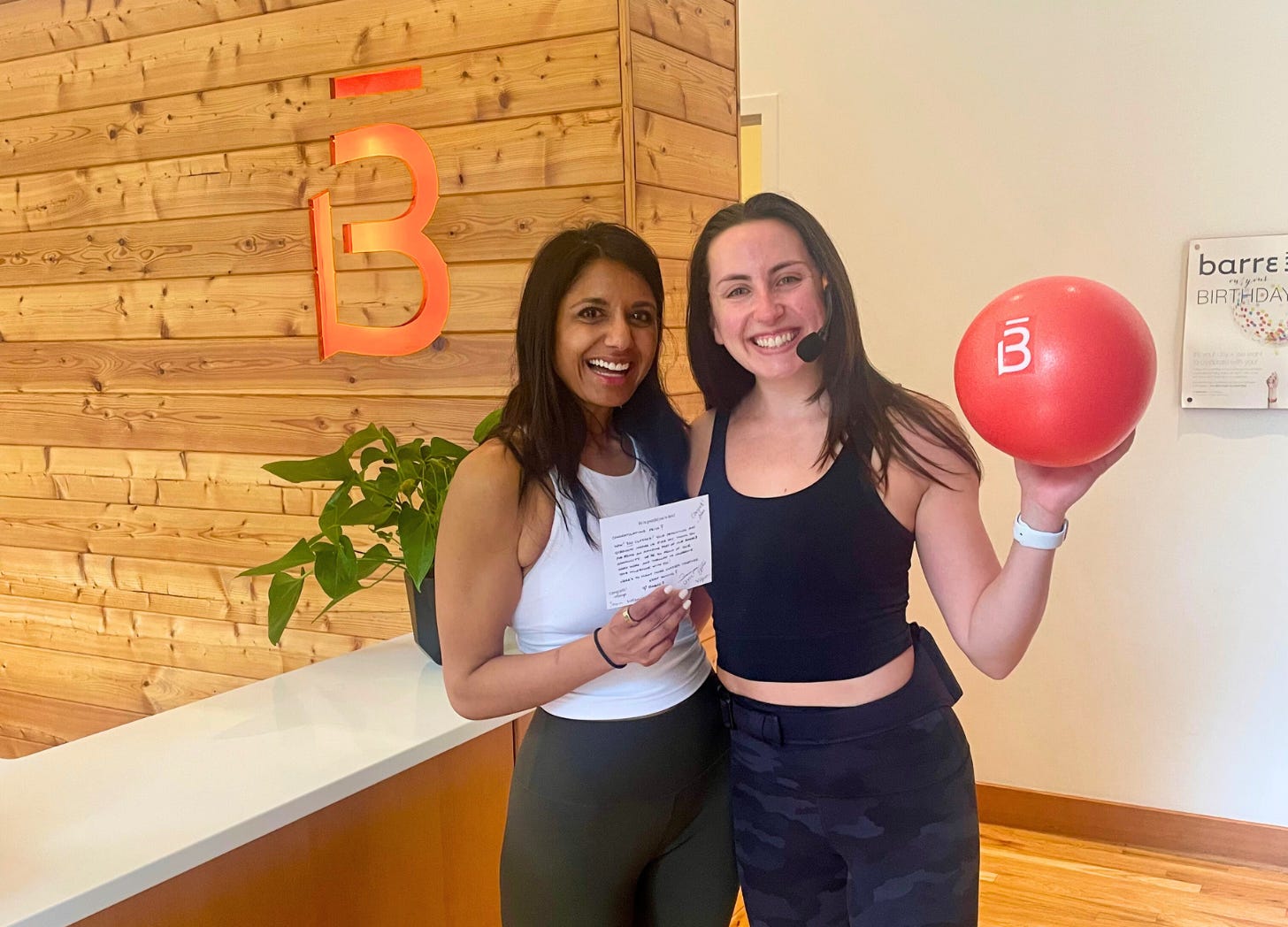
So, I learned to do what many ambitious women learn early:
Excel in ways that feels safe
Achieve quietly
Let competence be my entry point
Shrink the parts of me that might draw attention
And then, on the threshold of 40 and after having a child, here I was seen in a way that contradicted an old story I’d carried for decades.
It reminded me of something I knew but don’t always embody: Our perceptions are often not reality.
And sometimes, the only way to discover what’s possible is to be willing to be seen.
Because so many of us live with a lifetime of mixed messages, a reflection of why the and/or thinking is so ingrained in us.
We’re told to be successful but not intimidating, to be confident but not too much, to be visible but not take up too much space, to be ambitious but not make anyone uncomfortable.
So, we hide or perform. Either way, neither choice feels like freedom.
”I didn’t learn the value of visibility from being in front of the camera; I learned it from staying behind it.”
It’s time to start celebrating and being true to ourselves.
Visibility isn’t just about gaining attention; it’s about gaining access. As women, we are often uniquely positioned to share our industry knowledge alongside our lived experience.
When you share what you know, you:
Expand opportunities: roles, partnerships, speaking engagements, community
Become more trustworthy: people can’t value what they don’t see
Create permission for others: especially other women who are watching quietly
Shape narratives: rather than being shaped by them
However, when your visibility is driven by seeking approval, that performative behavior comes with a cost. It often leads to burnout, disconnection, superficial content, and chasing engagement. Your voice then loses its meaning.
Non-performative visibility is sustainable because it’s rooted in your identity and values. It doesn’t require you to be someone else to be seen. It encourages you to be more of yourself.
And if you’re thinking, “I don’t have anything groundbreaking to say,” it’s time to reframe. Your lived experience is expertise. Your perspective is valuable. Your clarity is leadership.
How to approach thought leadership.
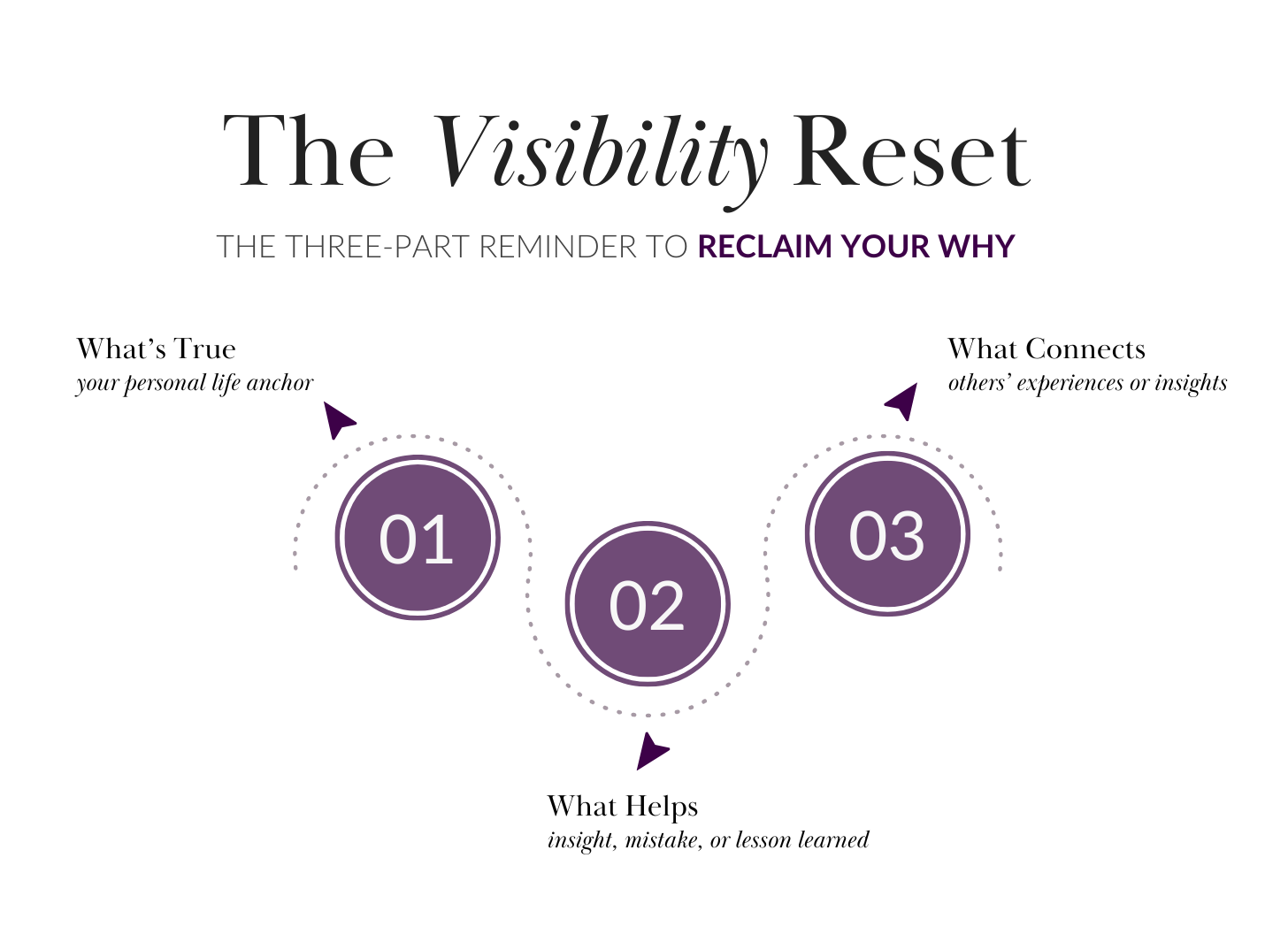
If you’ve been struggling to share content that is meaningful rather than performative, it can be difficult to know where to begin. So, I created a three-part visibility reset to remind you of your ‘why’.
It can be adapted and refined to focus on what matters most to you, whether it’s leadership, your industry, or something more passion-driven like a hobby or life experience.
First, choose what’s true: one area of your life that anchors you.
Second, determine what helps: one story, lesson, or mistake you’ve learned.
Third, identify what connects: others’ experiences or insight
Once you combine these three elements, you’ll have a framework for a post—just be careful not to overpolish or overthink it.
Not sure if it’s the right fit? Use the coffee test. Ask yourself, “Would I say this to a friend over coffee?” If not, rewrite it until you would.
Prompts:
”I used to think _________. Now, I know _________.”
”Here’s the truth I learned the hard way. _________.”
”If you’re dealing with _________, you’re not alone.”
Your story is worth sharing.
If you’ve ever felt like you needed to stay small to feel safe or like being visible requires a performance you can’t sustain, remember:
You don’t have to perform to earn respect.
You don’t have to prove your worth.
You don’t have to be perfect to be impactful.
Non-performative visibility is simply the courage to be seen as you are, and sometimes, when you take the risk to share what’s true, life surprises you.
Not because you become someone else, but because you finally give the world a chance to meet you.